The Hidden Cost of Disconnected Operations for Mold Inspection Companies
What's really slowing down mold inspection companies and mold remediation companies — and what the research says it's costing them.
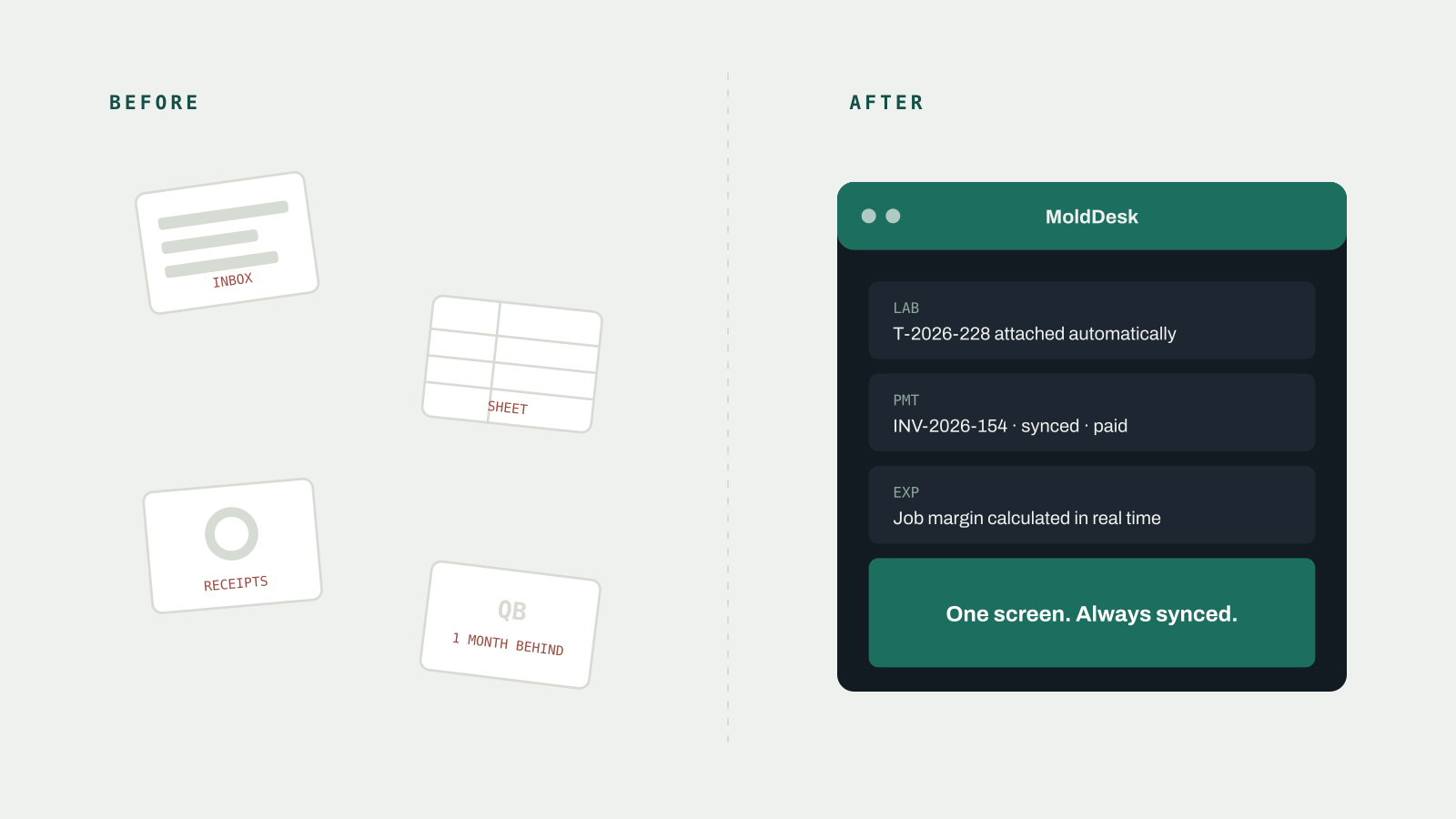
Mold inspection companies and mold remediation companies run on the same back-office ingredients as any service business — invoicing, payment collection, expense tracking — plus one thing the rest of the field-service world doesn't deal with: lab reports that have to be tied to the right test, the right client, and the right technician, every time.
Independent research on small and mid-sized service businesses consistently finds that owners lose significant time every month to manual bookkeeping and invoicing, that late payments routinely go unchased for weeks, and that a large share of business owners still run their finances on spreadsheets or paper. None of this research was conducted on mold inspection companies specifically — but the operating pattern it describes is one we've seen directly in mold inspection and remediation businesses, which additionally carry lab-report coordination on top of everything else.
The admin tax nobody budgets for
Across multiple 2025–2026 studies of small and mid-sized business owners, a consistent picture emerges: financial administration quietly consumes far more owner time than most businesses account for.
Small business owners who spend 5+ hours a month on manual invoicing are nearly 3× more likely to face cash-flow problems.— FreshBooks, State of Financial Flow, 2026
63% of small businesses spend time chasing payments — an average of 1.5 hours a week, or roughly 78 hours a year, per business.— GoCardless, Pursuing Payments Report, 2025

None of these studies were run specifically on mold inspection or mold remediation companies. But the businesses we've spoken with directly show the same pattern — and carry an extra layer these studies don't even measure: lab report coordination.
Where the time (and money) actually goes for mold companies
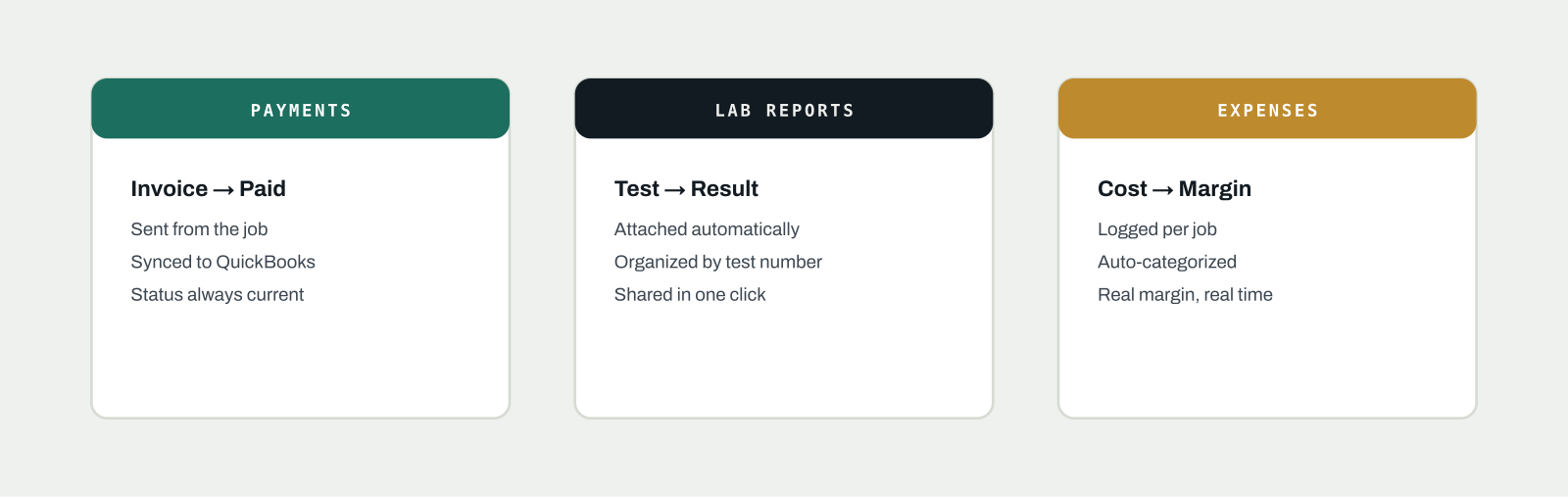
For a mold inspection company or mold remediation company, the general small-business admin burden shows up in three specific places.
1. Lab reports live outside the business record
A test gets scheduled, samples go to a lab, and results come back — usually to a shared inbox, not attached to the job record. Finding the right PDF for the right client, weeks later, becomes a manual search rather than a lookup.
2. Invoicing and payment status is reconstructed, not tracked
Without a system tying invoices to jobs automatically, "what's outstanding" becomes a question that requires checking a spreadsheet, an inbox, and QuickBooks separately — and reconciling all three by hand.
3. Job-level profitability is invisible until tax season
Lab fees, fuel, and technician time are real costs against every job — but when expenses are tracked separately from invoices, most mold remediation companies only find out whether a job was profitable months after the fact, if at all.
What changes with one connected system
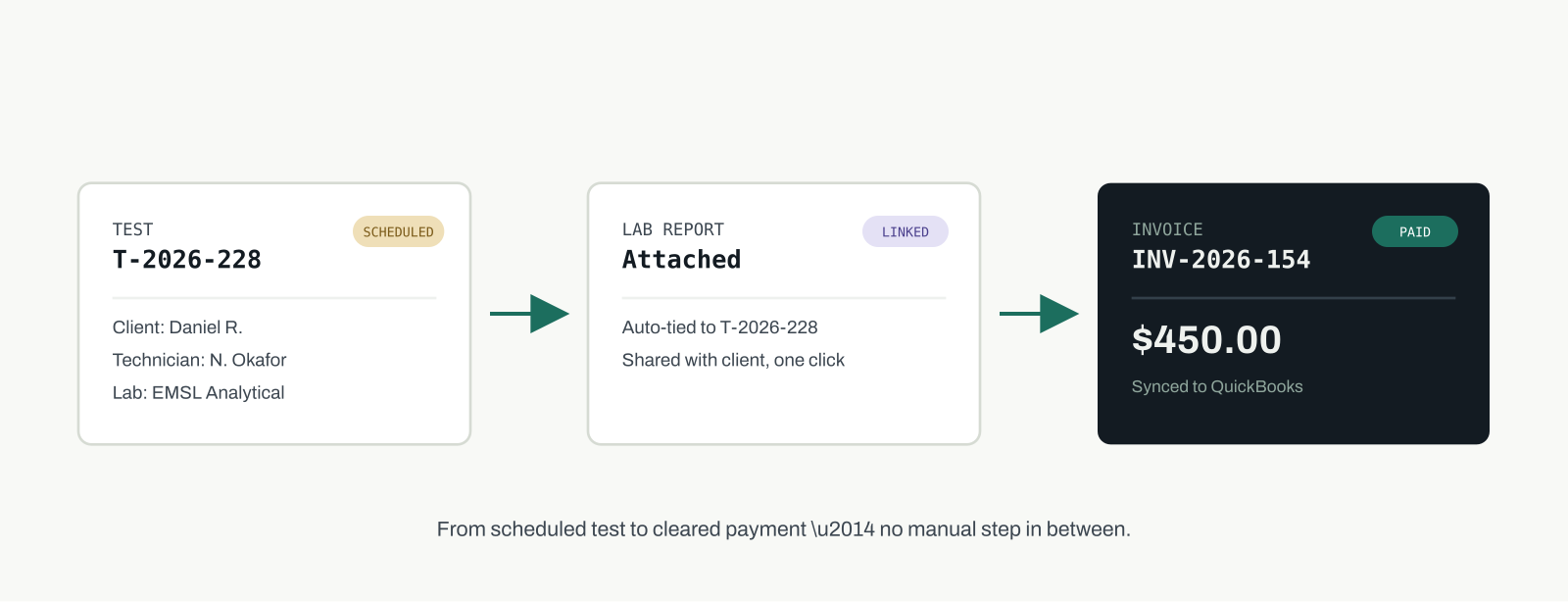
The fix implied by the research isn't more hours or more discipline — it's removing the manual reconciliation step entirely. When lab reports, invoicing, and expenses live in one system tied to the job:
- Lab results attach to the job automatically — no inbox search
- Invoice status (paid, due, overdue) is always current, not reconstructed
- Job-level profit is visible in real time, not at tax time
- QuickBooks stays synced automatically instead of being updated in a monthly batch
This is the specific gap MoldDesk was built to close for mold inspection companies and mold remediation companies — not a general accounting tool retrofitted with a mold label, but a system built around how a test becomes an invoice becomes a paid, reconciled job.
See it on your own jobs
MoldDesk ties lab reports, invoicing, and expenses to the job automatically — synced to QuickBooks from day one.
Get Started FreeSOURCES
FreshBooks. "The State of Financial Flow in 2026." freshbooks.com, April 2026.
GoCardless. "Pursuing Payments Report." 2025.
Addition Finance. "How Much Time Should Founders Spend on Bookkeeping?" 2026.
NerdWallet UK. "Survey: How Business Owners Are Prioritising Time and Money in 2025." 2025.
Figures above are drawn from general small-business research, not mold-industry-specific studies — cited here as the closest available independent data on the underlying admin burden. MoldDesk has not yet published mold-industry-specific benchmark data; this will be added as real customer data becomes available.